Participation • National Level Hackathon, IBM ICE
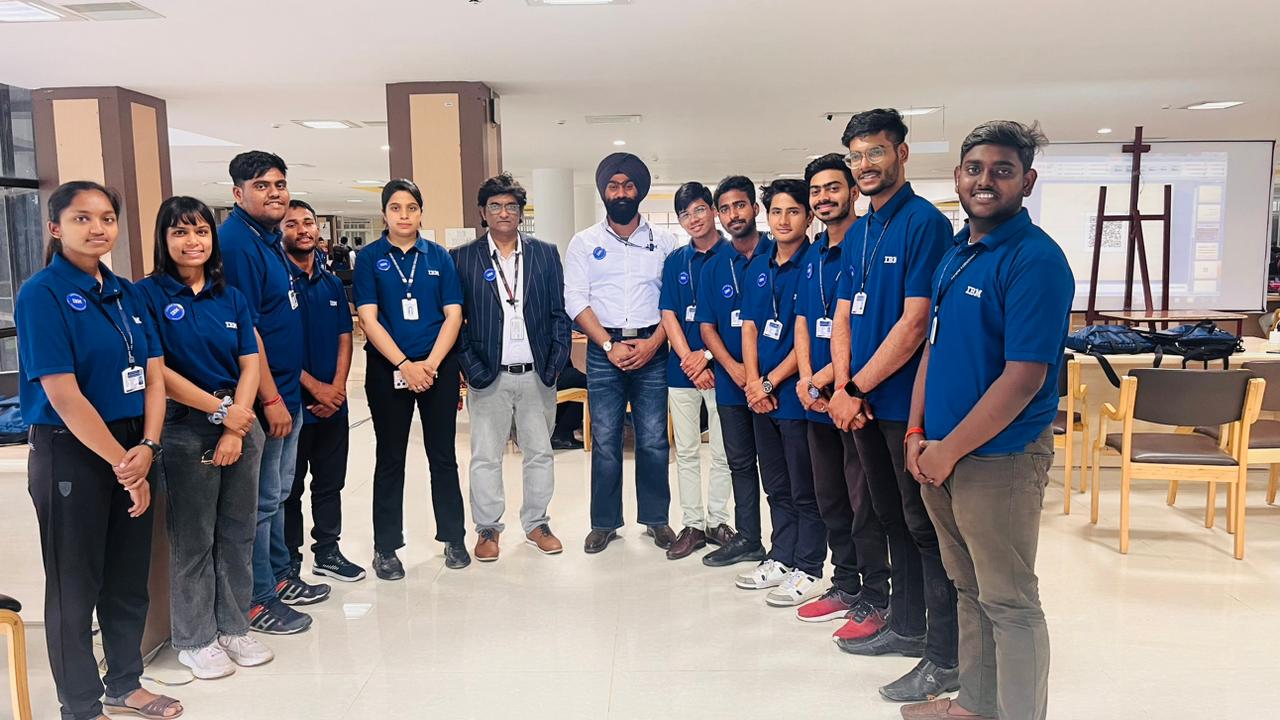
Team Path-Finders during the national-level hackathon experience at KARE, Madurai.
Stepping Beyond the Classroom
December 2023 marked an important step in our journey as Team Path-Finders. We participated in a National Level Hackathon organized by IBM ICE at Kalasalingam Academy of Research and Education (KARE), Madurai. For us, the event was an opportunity to move beyond the familiar environment of our university and test our technical skills in a larger, more competitive setting.
The project we took to the hackathon was our Air Quality Index (AQI) prediction solution. What made this experience particularly valuable was that we did not approach AQI as a simple academic exercise. We worked toward making the project fully functional using a substantially larger dataset covering five years of air-quality information from the Hyderabad region.
Working with a larger, real-world dataset changed the nature of the problem. Instead of focusing only on whether a model could produce predictions on a small sample, we had to think about data preparation, consistency, patterns across time, model performance and how the final system could turn historical environmental information into useful predictions.
Why Air Quality Became Our Problem to Solve
Air pollution is one of those problems that can be discussed through statistics but experienced in everyday life. Changes in air quality can affect how people travel, work, exercise and plan their day. AQI provides a way of communicating the overall state of air pollution in a form that is easier for people to understand than a collection of raw pollutant measurements.
Our interest in the problem came from the opportunity to use data science for something that has direct public relevance. Rather than building a model simply because a dataset was available, we wanted to explore how historical environmental data could be transformed into an intelligent prediction system.
The Hyderabad dataset gave us a meaningful setting for this work. With five years of regional data, the project had enough historical depth to make the exercise more realistic and to encourage us to look beyond individual observations toward broader patterns.
From a Dataset to a Functional System
One of the biggest differences between a classroom model and a hackathon-ready solution is the amount of work that happens before and around the model itself. A dataset rarely arrives perfectly prepared. It needs to be understood, cleaned, organized and transformed before it can be used effectively.
For our AQI project, working with five years of data required us to think carefully about the structure and quality of the information. We had to understand the available variables, prepare the data for modelling and make sure that the pipeline could handle a much larger volume of observations than the smaller datasets we had previously worked with.
This process helped us understand an important principle of data science: model performance depends heavily on the quality of the data pipeline. A sophisticated algorithm cannot compensate for poorly prepared data. The work of understanding and preparing the dataset is therefore part of the intelligence of the overall solution.
The Machine Learning Perspective
The AQI project gave us an opportunity to apply machine learning to an environmental prediction problem. Our work explored how historical air-quality information could be used to learn patterns and generate AQI-related predictions.
The model was only one part of the solution. We also had to consider how the input data would flow through the system, how predictions would be evaluated and how the output could be presented in a way that made sense to a user.
This was an important transition for us. Instead of thinking about machine learning as simply training a model and printing an accuracy score, we began to see it as an end-to-end process: understand the problem, prepare the data, train the model, evaluate the results and turn the output into something usable.
Working with Five Years of Hyderabad Data
The five-year Hyderabad dataset became one of the most valuable aspects of the project. A larger historical window allows a model-building exercise to move closer to the complexity of real-world environmental data, where conditions change over time and observations are not always uniform.
Working with this dataset encouraged us to look for trends, variations and relationships rather than treating each row as an isolated example. It also made us more conscious of the importance of consistent preprocessing and careful validation.
Most importantly, the larger dataset gave us confidence that the project was not merely a small demonstration. We were building and testing a functional AQI solution around a meaningful regional dataset, which made the hackathon experience much more technically demanding and rewarding.
Building Under Pressure at a National-Level Hackathon
A hackathon changes the rhythm of development. There is a fixed deadline, limited time for experimentation and constant pressure to decide what should be improved next. At a national-level event, that pressure is accompanied by the opportunity to compare your work with participants from different backgrounds and institutions.
For Team Path-Finders, this meant quickly moving between technical work, discussions, debugging, refinement and presentation preparation. Every hour mattered. We had to prioritize the parts of the project that created the most value and avoid getting lost in unnecessary complexity.
The experience taught us that technical knowledge is only one part of hackathon success. Time management, communication, adaptability and the ability to make decisions as a team are equally important.
Presenting a Data Science Project to a Larger Audience
Presenting an AQI prediction system also required us to translate technical concepts into a story that a broader audience could understand. We had to explain why air quality matters, what data we used, what the system was designed to do and how machine learning contributed to the solution.
This forced us to look at our project from the perspective of someone who had not been involved in building it. Which information should come first? What does the prediction actually mean? Why should someone trust the output? These questions helped us improve the way we communicated technical work.
The experience reinforced a lesson that has stayed with me: a strong data science project is not complete when the model works. It becomes valuable when its results can be understood and connected to a real decision or real-world need.
The Team Path-Finders Experience
Being part of Team Path-Finders made the hackathon more than an individual technical exercise. The project involved shared responsibility, discussion and continuous coordination. Different parts of the work had to come together into one coherent solution and one coherent presentation.
Working together under a deadline also taught us how to handle disagreements productively. In a hackathon, there is rarely enough time to explore every possible approach. The team has to compare alternatives, choose a direction and move forward.
That experience strengthened not only our technical abilities but also our ability to collaborate on projects where the requirements are evolving and the deadline is fixed.
What the Madurai Hackathon Taught Me
The Madurai hackathon was an important learning experience because it pushed me to think about data science at a larger scale. Working with five years of AQI data made data preparation, model development and evaluation feel much closer to real project work than a small classroom dataset.
It also helped me understand that a machine learning project is a system rather than a single algorithm. Data quality, feature preparation, model selection, evaluation and presentation all influence the final outcome.
Most importantly, the event gave me confidence to take projects beyond experimentation. A model developed in a notebook is a useful starting point, but the larger goal is to create something functional, understandable and capable of supporting a real use case.
Where the AQI Project Can Go Next
The AQI project has considerable scope for future development. A more advanced version could incorporate real-time air-quality feeds, weather information, location-aware predictions and richer visualization. Historical trends could be combined with live observations to provide more useful forecasts.
Future versions could also explore longer forecasting horizons, more sophisticated time-series approaches, anomaly detection and personalized alerts. A user-facing application could allow people to select a location and understand both current conditions and predicted air-quality changes.
Another important direction would be explainability. Rather than showing only a predicted AQI value, the system could communicate which environmental factors contributed most strongly to the prediction. This would make the model more transparent and potentially more useful for decision-making.
A Milestone in Our Data Science Journey
Participating in a national-level hackathon at KARE, Madurai, was more than another item on our list of events. It was an opportunity to take a data science problem, work with a larger five-year regional dataset and turn our earlier AQI experimentation into a more complete and functional project.
The experience strengthened my interest in building practical machine learning systems and showed me the importance of moving from small experiments toward robust, data-driven solutions.
For Team Path-Finders, the hackathon became another chapter in a journey defined by learning through building. We entered with an AQI idea, challenged ourselves with a larger dataset, worked under competition pressure and came away with a much stronger understanding of what it takes to turn environmental data into an intelligent application.
I am grateful to my teammates, mentors, organizers and everyone who contributed to the experience. The photographs from Madurai capture the event, but the real value of the experience lies in what happened behind them: the data we explored, the problems we solved, the decisions we made and the confidence we gained.
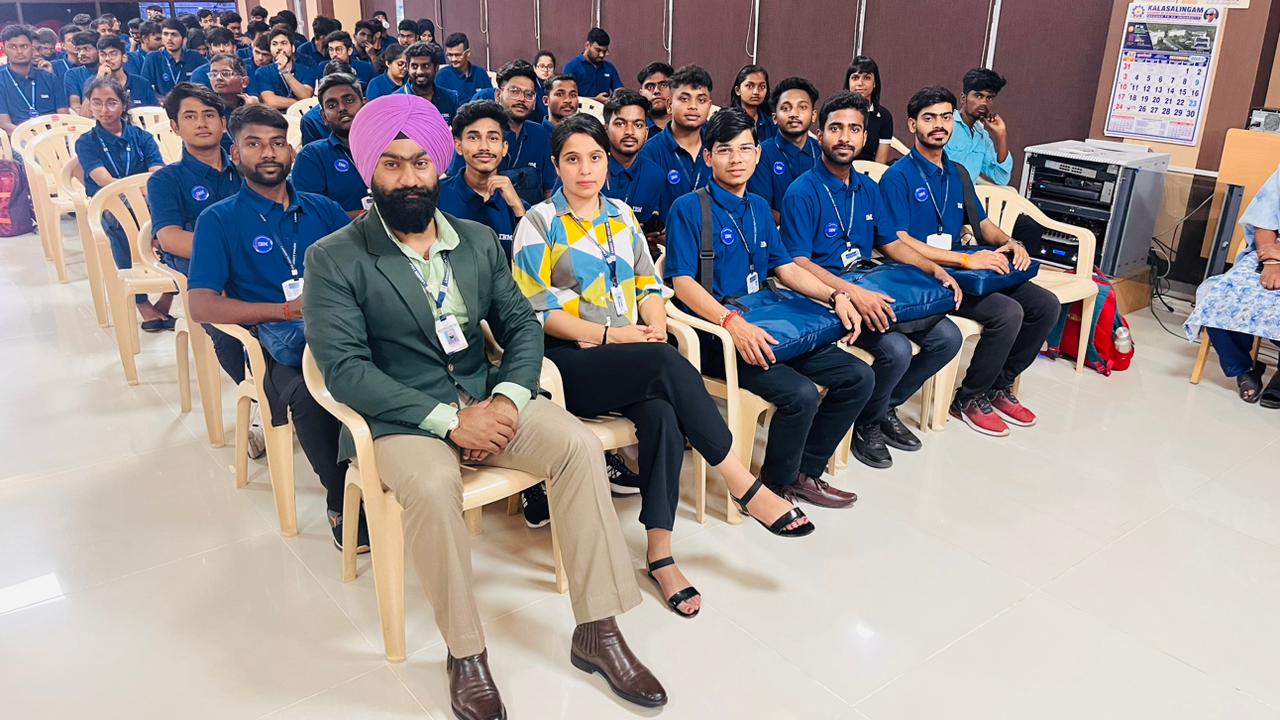
Team Path-Finders during the hackathon sessions and collaborative learning experience at KARE.