1st Prize • Hackathon, Yuva Fest • Lamrin Tech Skills University
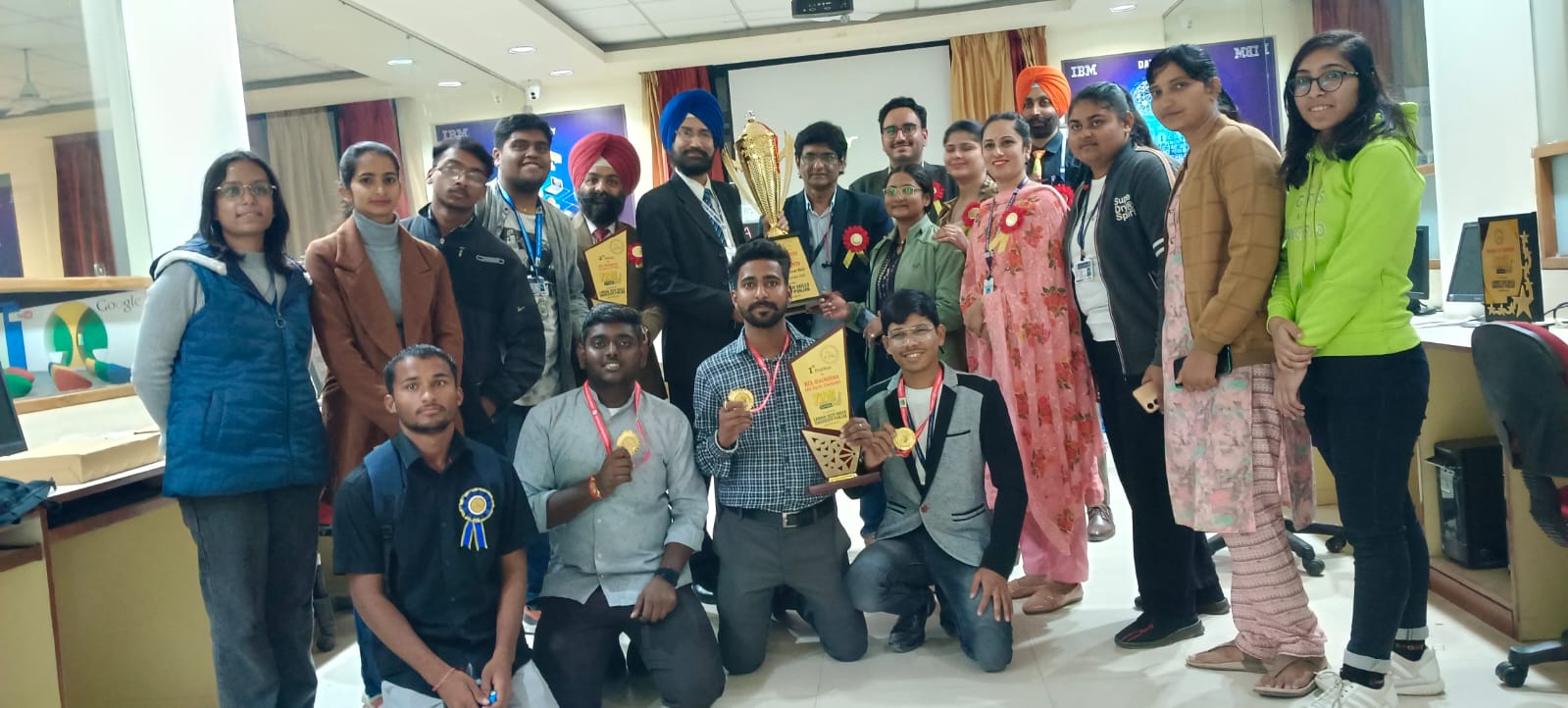
Team Path-Finders celebrating the winning Kodeathon (HLC) achievement at Yuva Fest 2023.
The Beginning: Learning by Doing
Some achievements become special because of the prize. Others become special because of how far you had to travel to reach them. Our Kodeathon (HLC) experience at Yuva Fest 2023 at Lamrin Tech Skills University Punjab belongs to the second category.
When Team Path-Finders participated in the Kodeathon, we were still early in our journey of learning web development. We had only about one semester of exposure to technologies such as Bootstrap, yet we decided to take that limited experience and turn it into a complete project. The result was E-Waste Rahi, a web-based idea designed to help people locate nearby waste-management facilities and make responsible disposal of electronic waste easier.
The most memorable part was that E-Waste Rahi was not built after years of experience. It was built while we were still learning. We learned Bootstrap, understood how websites are structured, experimented with layouts and then applied those skills to a real problem. Eventually, the project secured the top position in the Kodeathon (HLC), turning a learning exercise into one of our earliest major achievements.
The Problem We Wanted to Solve
Electronic waste is easy to ignore because it often begins with something small: an old phone, damaged charger, unused electronic accessory, outdated computer component or another device that has reached the end of its useful life. The challenge begins when people do not know what to do with it.
Throwing electronic waste into ordinary waste streams can contribute to environmental problems and can prevent valuable materials from being recovered responsibly. Yet even when people want to dispose of e-waste properly, finding a nearby facility or collection point can be inconvenient.
That gap between intention and action became the foundation for E-Waste Rahi. The idea was simple: make it easier for users to find nearby waste-management facilities so that responsible disposal becomes a more accessible choice.
Introducing E-Waste Rahi
E-Waste Rahi was designed as a nearby waste-management facility locator. Instead of expecting users to search through multiple sources or depend on word of mouth, the concept focused on providing a convenient digital route toward appropriate disposal facilities.
The project represented a straightforward but meaningful product philosophy: technology does not always have to solve a complicated problem to create value. Sometimes, the biggest improvement comes from reducing friction in an everyday decision.
The name 'Rahi' reflected this idea of guidance and companionship. The platform was envisioned as a digital companion that could guide a user toward a responsible destination for electronic waste.
Building the Project with Bootstrap
One of the most important aspects of this project was the technology we used to build it. At that stage, Bootstrap was still a relatively new skill for us. We had learned it within roughly one semester and then had to move quickly from learning individual concepts to applying them in a complete project.
Bootstrap gave us a practical foundation for building the website's responsive interface. We learned how grids, containers, navigation components, cards, buttons and responsive layouts could work together to create a consistent user experience.
What made the experience valuable was that we were not simply following a tutorial. We were learning a technology and immediately asking ourselves how it could help us solve a problem. Every layout decision became part of the learning process: how should the facility information be displayed, how should users navigate the website, how can the interface remain understandable, and how can the site adapt to different screen sizes?
E-Waste Rahi therefore became more than a competition project. It became one of our first practical laboratories for frontend development.
From Classroom Concepts to a Complete Project
Building a complete project in a competition environment is very different from completing isolated classroom exercises. A classroom assignment may focus on a specific concept. A project requires those concepts to work together.
For E-Waste Rahi, we had to think about the user experience, the structure of the website, the visual hierarchy and the overall flow. We also had to make decisions about what information mattered and how it should be presented.
That shift—from learning a technology to using it as a tool—was one of the biggest lessons of the Kodeathon. We began to understand that programming skills become much more powerful when they are connected to a clear problem and a defined user.
Working as Team Path-Finders
Teamwork was another important part of the achievement. Team Path-Finders gave us an environment where ideas could be discussed, challenged and improved. A project built under competition pressure requires people to move quickly between brainstorming, implementation, testing and presentation.
The team experience also taught us that not every idea needs to become a feature. Time is limited in a Kodeathon, so we had to focus on the core value of E-Waste Rahi rather than trying to build an unnecessarily large platform.
That discipline—deciding what matters most and delivering it clearly—is a lesson that has continued to influence the way we approach later projects and hackathons.
The Kodeathon Experience
Yuva Fest 2023 provided the setting for an experience that combined learning, competition and celebration. Presenting E-Waste Rahi in front of evaluators meant that we had to explain more than the website itself. We had to communicate why the problem mattered, what our solution was trying to achieve and how we had used technology to build it.
Because the project was created from skills we had only recently acquired, presenting it was also a confidence-building experience. It showed us that being a beginner in a technology does not mean waiting until you become an expert before attempting something meaningful. Sometimes the fastest way to learn is to build something that matters.
The competition also taught us to accept feedback and look at our work from an external perspective. What seems obvious to the developer may not be obvious to the user. That realization encouraged us to think more carefully about clarity, simplicity and usability.
The Moment We Became Winners
When Team Path-Finders achieved the top position in the Kodeathon (HLC), the result felt much bigger than a competition ranking. It represented the distance between where we started and what we managed to create in a relatively short period.
We had learned Bootstrap only about a semester earlier. We then used it to build a complete project around a real-world environmental problem, presented that project in a competitive setting and finished at the top. The achievement gave us confidence that learning by building could produce results much faster than we had imagined.
The trophy and photographs from that day capture the celebration, but the real achievement was the learning behind them.
What E-Waste Rahi Taught Me
Personally, E-Waste Rahi taught me one of the most important lessons of my early technical journey: do not wait until you know everything before you start building.
When we began learning Bootstrap, we could have treated it as another technology to study and eventually add to a list of skills. Instead, the Kodeathon gave us a reason to apply it immediately. That changed the learning process. Concepts became easier to remember because they were connected to an actual product.
The project also strengthened my understanding of user-centered development. A website is not successful simply because it works technically. It needs to make sense to the person using it. In the case of E-Waste Rahi, the goal was to reduce the effort required to find a responsible disposal option.
The Bigger Vision Behind the Idea
Although the Kodeathon project was focused on locating nearby waste-management facilities, the idea has room to grow. A more advanced version of E-Waste Rahi could include categorized e-waste information, facility verification, collection scheduling, recycling guidance, awareness resources and location-based recommendations.
Future versions could also integrate maps, geolocation and smarter recommendations to help users identify the most appropriate nearby facility. The platform could potentially connect households, educational institutions, businesses, collection centers and recycling organizations within a broader digital ecosystem.
The core idea would remain the same: make responsible e-waste disposal easier by reducing the gap between people who want to dispose of electronics properly and the facilities equipped to handle them.
A Milestone That Started Something Bigger
Looking back, the Kodeathon at Yuva Fest 2023 was one of those experiences that quietly changed the direction of our learning. We entered with limited experience, built a complete Bootstrap-based project and left as winners.
E-Waste Rahi may have been an early project, but it taught us principles that continue to matter: start with a real problem, learn the tools needed to solve it, build quickly, listen to feedback, work as a team and keep improving.
For Team Path-Finders, the victory was not simply about being ranked first. It was proof that a small amount of knowledge, when combined with curiosity, teamwork and the courage to build, can become something meaningful.
I am grateful to my teammates, mentors, faculty members and everyone at Lamrin Tech Skills University Punjab who gave us the platform to participate, experiment and compete. The Kodeathon achievement remains a memorable milestone because it was one of the first times we saw our newly acquired technical skills turn into a project that could solve a real-world problem.
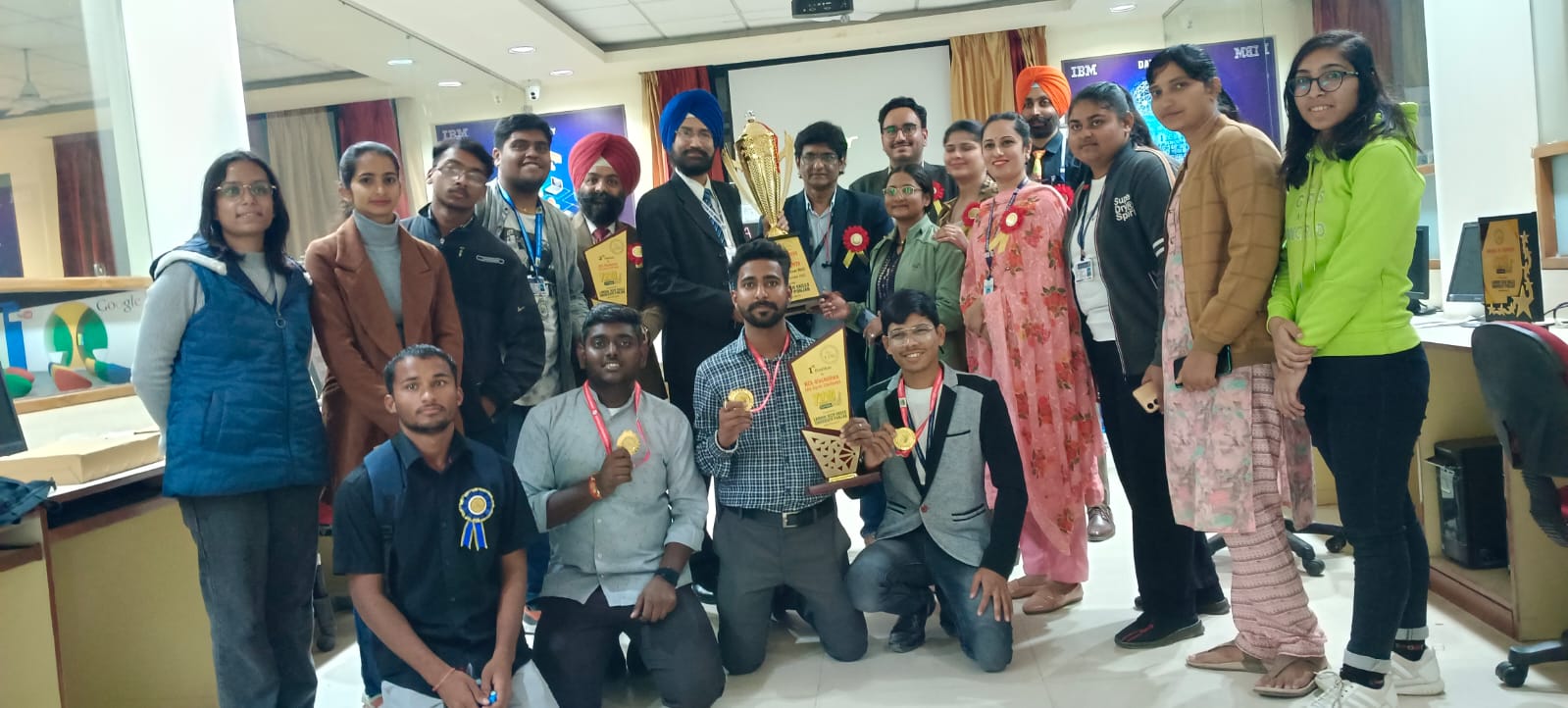
A second view of the winning moment with Team Path-Finders, the trophy and the wider Yuva Fest community.